Every database has to solve the same basic problem.
Data lives on disk, and accessing disk is slow. Every read and every write eventually has to reach the disk, and how a database organizes data on that disk determines everything about its performance.
Over decades of research, two dominant approaches have emerged.
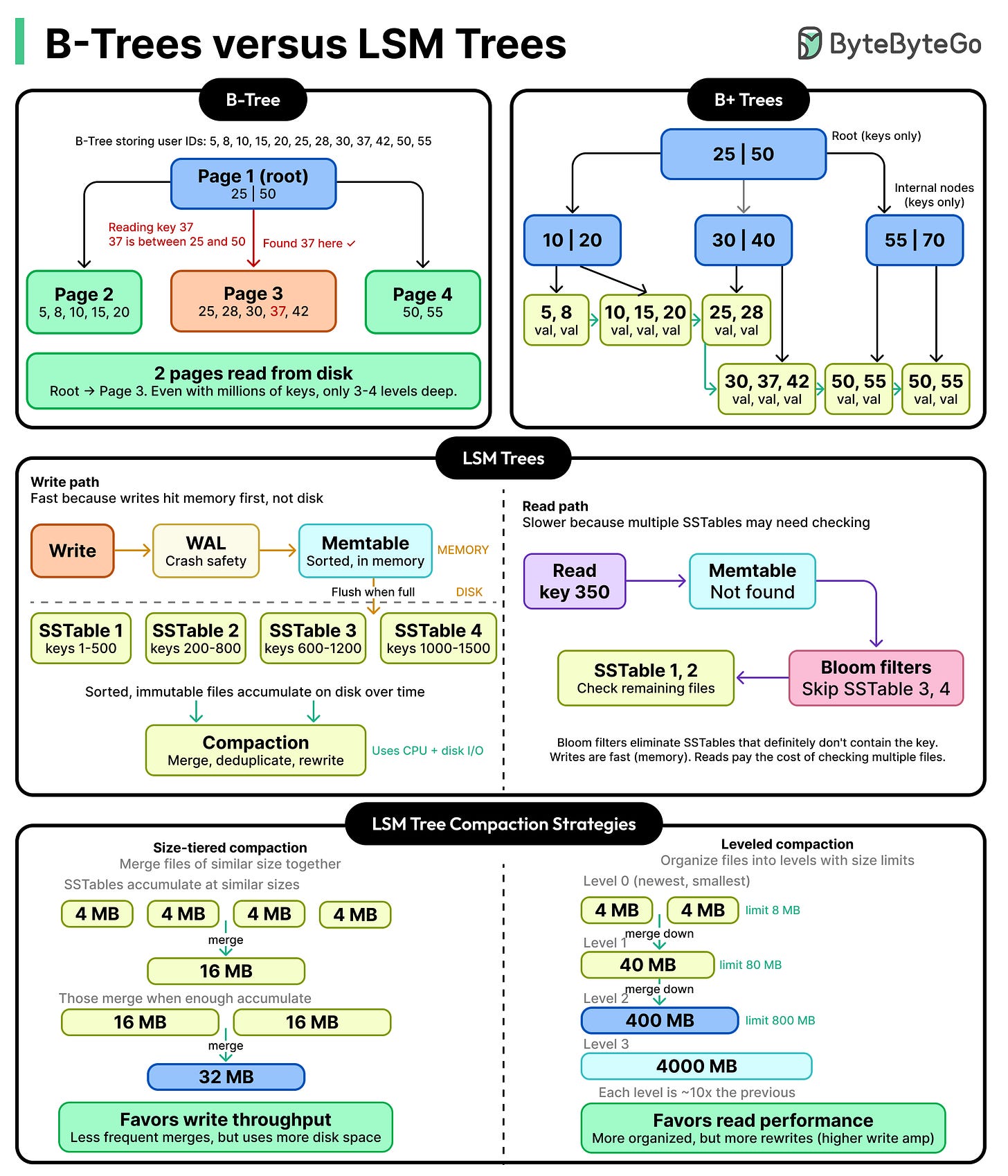
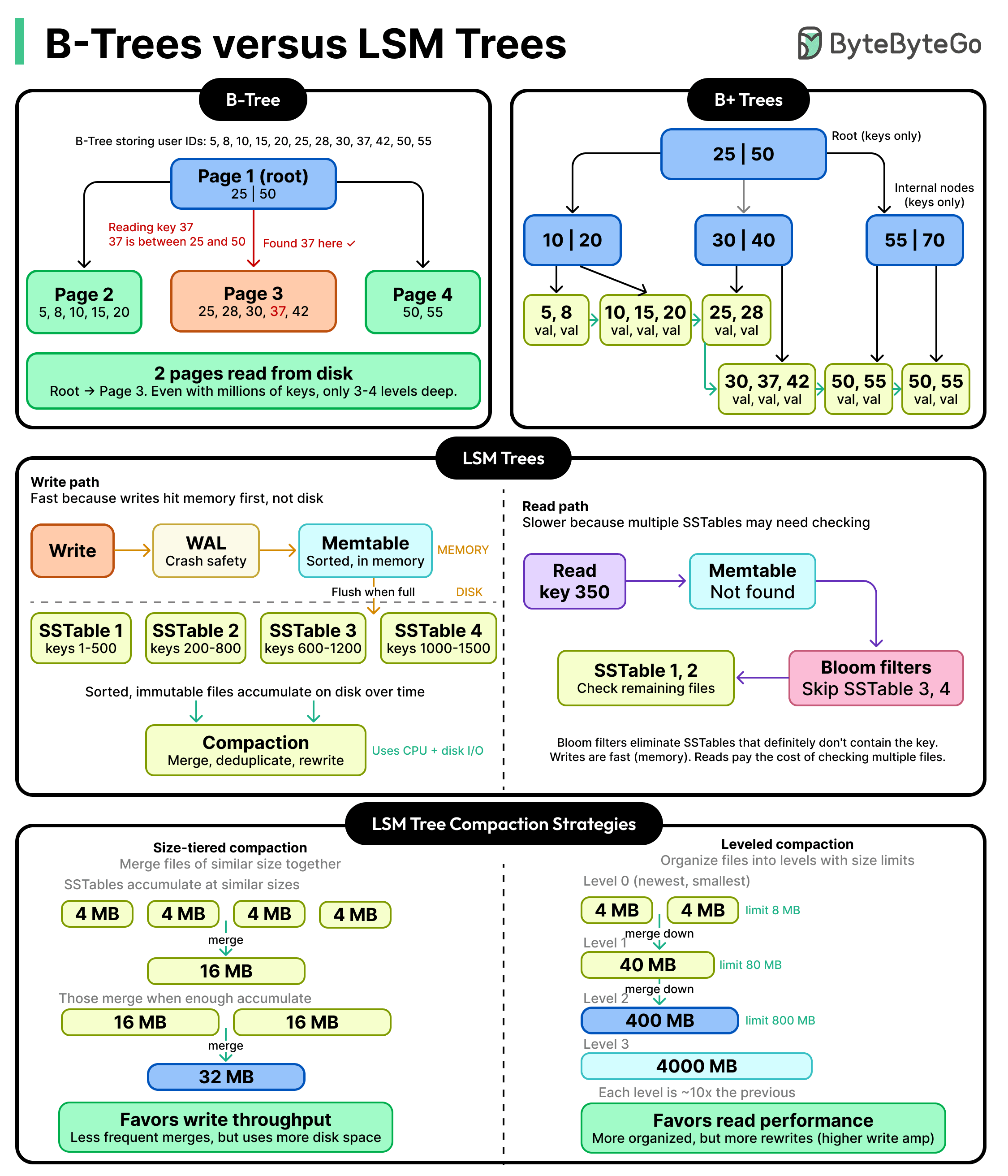
B-Trees keep data sorted on disk so reads are fast, but pay for it on every write.
LSM Trees buffer writes in memory and flush them to disk in bulk, making writes cheap but reads more expensive.
Neither approach is better. They represent two different approaches, and understanding the tradeoff between them is one of the most useful mental models in system design.
In this article, we will look at B-Trees and LSM trees in detail, along with the trade-offs associated with each of them.
When the robotics engineering field that Maja Matarić wanted to work in didn’t exist, she helped create it. In 2005 she helped define the new area of socially assistive robotics.
As an associate professor of computer science, neuroscience, and pediatrics at the University of Southern California, in Los Angeles, she developed robots to provide personalized therapy and care through social interactions.
Maja Matarić
Employer
University of Southern California, Los Angeles
Job Title
Professor of computer science, neuroscience, and pediatrics
Member grade
Fellow
Alma maters
University of Kansas and MIT
The robots could have conversations, play games, and respond to emotions.
Today the IEEE Fellow is a professor at USC. She studies how robots can help students with anxiety and depression undergo cognitive behavioral therapy. CBT focuses on changing a person’s negative thought patterns, behaviors, and emotional responses.
For her work, she received a 2025 Robotics Medal from MassRobotics, which recognizes female researchers advancing robotics. The Boston-based nonprofit provides robotics startups with a workspace, prototyping facilities, mentorship, and networking opportunities.
When receiving the award at the ceremony in Boston, Matarić was overcome with joy, she says.
“I’ve been very fortunate to be honored with several awards, which I am grateful for. But there was something very special about getting the MassRobotics medal, because I knew at least half the people in the room,” she says. “Everyone was just smiling, and there was a great sense of love.”
Seeing herself as an engineer
Matarić grew up in Belgrade, Serbia. Her father was an engineer, and her mother was a writer. After her father died when she was 16, Matarić and her mother moved to the United States.
She credits her father for igniting her interest in engineering, and her uncle who worked as an aerospace engineer for introducing her to computer science.
Matarić says she didn’t consider herself an engineer until she joined USC’s faculty, since she always had worked in computer science.
“In retrospect, I’ve always been an engineer,” Matarić says. “But I didn’t set out specifically thinking of myself as one—which is just one of the many things I like to convey to young people: You don’t always have to know exactly everything in advance.”
Maja Matarić and her lab are exploring how socially assistive robots can help improve the communication skills of children with autism spectrum disorder. National Science Foundation News
While pursuing her bachelor’s degree in computer science at the University of Kansas in Lawrence, she was introduced to industrial robotics through a textbook. After earning her degree in 1987, she had an opportunity to continue her education as a graduate student at MIT’s AI Lab (now the Computer Science and Artificial Intelligence Lab). During her first year, she explored the different research projects being conducted by faculty members, she said in a 2010 oral history conducted by the IEEE History Center. She met IEEE Life Fellow Rodney Brooks, who was working on novel reactive and behavior-based robotic systems. His work so excited her that she joined his lab and conducted her master’s thesis under his tutelage.
Inspired by the way animals use landmarks to navigate, Matarić developed Toto, the first navigating behavior-based robot. Toto used distributed models to map the AI Lab building where Matarić worked and plan its path to different rooms. Toto used sonar to detect walls, doors, and furniture, according to Matarić’s paper, “The Robotics Primer.”
After earning her master’s degree in AI and robotics in 1990, she continued to work under Brooks as a doctoral student, pioneering distributed algorithms that allowed a team of up to 20 robots to execute complex tasks in tandem, including searching for objects and exploring their environment.
Matarić earned her Ph.D. in AI and robotics in 1994 and joined Brandeis University, in Waltham, Mass., as an assistant professor of computer science. There she founded the Interaction Lab, where she developed autonomous robots that work together to accomplish tasks.
Three years later, she relocated to California and joined USC’s Viterbi School of Engineering as an assistant professor in computer science and neuroscience.
In 2002 she helped to found the Center for Robotics and Embedded Systems (now the Robotics and Autonomous Systems Center). The RASC focuses on research into human-centric and scalable robotic systems and promotes interdisciplinary partnerships across USC.
Matarić’s shift in her research came after she gave birth to her first child in 1998. When her daughter was a bit older and asked Matarić why she worked with robots, she wanted to be able to “say something better than ‘I publish a lot of research papers,’ or ‘it’s well-recognized,’” she says.
“In academia, you can be in a leadership role and still do research. It’s a wonderful and important opportunity that lets academics be on top of our field and also train the next generation of students and help the next generation of faculty colleagues.”
“Kids don’t consider those good answers, and they’re probably right,” she says. “This made me realize I was in a position to do something different. And I really wanted the answer to my daughter’s future question to be, ‘Mommy’s robots help people.’”
Matarić and her doctoral student David Feil-Seifer presented a paper defining socially assistive robotics at the 2005 International Conference on Rehabilitation Robotics. It was the only paper that talked about helping people complete tasks and learn skills by speaking with them rather than by performing physical jobs, she says.
Feil-Seifer is now a professor of computer science and engineering at the University of Nevada in Reno.
At the same time, she founded the Interaction Lab at USC and made its focus creating robots that provide social, rather than physical, support.
“At this point in my career journey, I’ve matured to a place where I don’t want to do just curiosity-driven research alone,” she says. “Plenty of what my team and I do today is still driven by curiosity, but it is answering the question: ‘How can we help someone live a better life?’”
In 2006 she was promoted to full professor and made the senior associate dean for research in USC’s Viterbi School of Engineering. In 2012 she became vice dean for research.
“In academia, you can be in a leadership role and still do research,” she says. “It’s a wonderful and important opportunity that lets academics be on top of our field and also train the next generation of students and help the next generation of faculty colleagues.”
Research in socially assistive robotics
One of the longest research projects Matarić has led at her Interaction Lab is exploring how socially assistive robots can help improve the communication skills of children with autism spectrum disorder. ASD is a lifelong neurological condition that affects the way people interact with others, and the way they learn. Children with ASD often struggle with social behaviors such as reading nonverbal cues, playing with others, and making eye contact.
Matarić and her team developed a robot, Bandit, that can play games with a child and give the youngster words of affirmation. Bandit is 56 centimeters tall and has a humanlike head, torso, and arms. Its head can pan and tilt. The robot uses two FireWire cameras as its eyes, and it has a movable mouth and eyebrows, allowing it to exhibit a variety of facial expressions, according to the IEEE Spectrum’s robots guide. Its torso is attached to a wheeled base.
The study showed that when interacting with Bandit, children with ASD exhibited social behaviors that were out of the ordinary for them, such as initiating play and imitating the robot.
Matarić and her team also studied how the robot could serve as a social and cognitive aid for elderly people and stroke patients. Bandit was programmed to instruct and motivate users to perform daily movement exercises such as seated aerobics.
Maja Matarić and doctoral student Amy O’Connell testing Blossom, which is being used to study how it can aid students with anxiety or depression.University of Southern California
Over the years, Matarić’s lab developed other robots including Kiwi and Blossom. Kiwi, which looked like an owl, helped children with ASD learn social and cognitive skills, helped motivate elderly people living alone to be more physically active, and mediated discussions among family members. Blossom, originally developed at Cornell, was adapted by the Interaction Lab to make it less expensive and personalizable for individuals. The robot is being used to study how it can aid students with anxiety or depression to practice cognitive behavioral therapy.
Matarić’s line of research began when she learned that large language model (LLM) chatbots were being promoted to help people with mental health struggles, she said in an episode of the AMA Medical News podcast.
“It is generally not easy to get [an appointment with a] therapist, or there might not be insurance coverage,” she said. “These, combined with the rates of anxiety and depression, created a real need.”
That made the chatbot idea appealing, she says, but she was interested to see if they were effective compared with a friendly robot such as Blossom.
Matarić and her team used the same LLMs to power CBT practice with a chatbot and with Blossom. They ran a two-week study in the USC dorms, where students were randomly assigned to complete CBT exercises daily with either a chatbot or the robot. Participants filled out a clinical assessment to measure their psychiatric distress before and after each session.
The study showed that students who interacted with the robot experienced a significant decrease in their mental state, Matarić said in the podcast, and students who interacted with the chatbot did not.
“Joining an [IEEE] society has an impact, and it can be personal. That’s why I recommend my students join the organization—because it’s important to get out there and get connected.”
She and her team also reviewed transcripts of conversations between the students and the robot to evaluate how well the LLM responded to the participants. They found the robot was more effective than the chatbot, even though both were using the same model.
Based on those findings, in 2024 Matarić received a grant from the U.S. National Institute of Mental Health to conduct a six-week clinical trial to explore how effective a socially assistive robot could be at delivering CBT practice. The trial, currently underway, also is expected to study how Blossom can be personalized to adapt to each user’s preferences and progress, including the way the robot moves, which exercises it recommends, and what feedback it gives.
During the trial, the 120 students participating are wearing Fitbits to study their physiologic responses. The participants fill out a clinical assessment to measure their psychiatric distress before and after each session.
Data including the participants’ feelings of relating to the robot, intrinsic motivation, engagement, and adherence will be assessed by the research team, Matarić says.
She says she’s proud of the graduate students working on this project, and seeing them grow as engineers is one of the most rewarding parts of working in academia.
“Engineers generally don’t anticipate having to work with human study participants and needing to understand psychology in addition to the hardcore engineering,” she says. “So the students who choose to do this research are just wonderful, caring people.”
Matarić credits IEEE Life Fellow George Bekey, the founding editor in chief of the IEEE Transactions on Robotics, for recruiting her for the USC engineering faculty position. He knew of her work through her graduate advisor Brooks, who published a paper in the journal that introduced reactive control and the subsumption architecture, which became the foundation of a new way to control robots. It is his most cited paper. Bekey, who was editor in chief at the time, helped guide Brooks through the challenging review process. Matarić joined Brooks’s lab at MIT two years after its publication, and her work on Toto built on that foundation.
“Joining a society has an impact, and it can be personal,” she says. “That’s why I recommend my students join the organization—because it’s important to get out there and get connected.”
Tom Burick has always considered himself a builder. Over the years he’s designed robots, constructed a vintage teardrop trailer, and most recently, led a group of students in building a full-scale replica of a pivotal 1940s computer.
Burick is a technology instructor at PS Academy in Gilbert, Ariz., a middle and high school for students with autism and other specialized learning needs. At the start of the 2025–26 school year, he began a project with his students to build a full-scale replica of the Electronic Numerical Integrator and Computer, or ENIAC, for the 80th anniversary of the historic computer’s construction. ENIAC was one of the world’s first programmable electronic computers. When it was built, it was about one thousand times as fast as other machines.
Before becoming a teacher, Burick owned a robotics company for a decade in the 2000s. But when a financial downturn forced him to close the business, he turned to teaching. “I had so many amazing people help me when I was young [who] really gave me their time and resources, and really changed the trajectory of my life,” Burick says. “I thought I need to pay that forward.”
Becoming a Roboticist
As a young child in Latrobe, Pa., Burick watched the television show Lost in Space, which includes a robot character who protects the family. “He was the young boy’s best friend, and I was so captivated by that. I remember thinking to myself, I want that in my life. And that started that lifelong love affair with robotics and technology.”
He started building toy robots out of anything he could find, and in junior high school, he began adding electronics. “By early high school, I was building full-fledged autonomous, microprocessor-controlled machines,” he says. At age 15, he built a 150-pound steel firefighting robot, for which he won awards from IEEE and other organizations.
Burick kept building robots and reached out for help from local colleges and universities. He first got in touch with a student at Carnegie Mellon University, who invited him to visit campus. “My parents drove me down the next weekend, and he gave me a tour of the robotics lab. I was mesmerized. He sent me home with college textbooks and piles of metal and gears and wires,” Burick says. He would read the textbook a page at a time, reading it again and again until he felt he had an understanding of it. Then, to help fill gaps in his understanding, he got in touch with a robotics instructor at Saint Vincent College, in his hometown of Latrobe, who let him sit in on classes. Each of these adults, he says, “helped change the trajectory of my life.”
Toward the end of high school, Burick realized that college wouldn’t be the right environment for him. “I was drawn to real-world problem-solving rather than structured coursework and I chose to continue along that path,” he says. Additionally, Burick has dyscalculia, which makes traditional mathematics more challenging for him. “It pushed me to develop alternative methods of engineering.”
The ENIAC replica Burick’s students built precisely matches what the original computer would have looked like before it was disassembled in the 1950s. Robert Gamboa
When he graduated, he worked in several tech jobs before starting his own company. In 2000, he opened a computer retail store and adjacent robotics business, White Box Robotics. The idea for the company came when Burick was building a “white box” PC from standard, off-the-shelf components, and realized there was no comparable product for robotics.
So, he started developing a modular, general-purpose platform that applied white box PC standards to mobile robots. “The robot’s chassis was like a box of Legos,” he says. You could click together two torsos to double its payload, switch out the drive system, or swap its head for a different set of sensors. He filed utility and design patents for the platform, called the 914 PC-Bot, and after merging with a Canadian defense robotics company called Frontline Robotics, started production. They sold about 200 robots in 17 countries, Burick says.
Then the 2008 financial crisis hit. White Box Robotics held on for a couple of years, shuttering in late 2010. “I got to live my life’s dream for 10 years,” he says. After closing White Box, “there was some soul searching” about what to do next. He recalled the impact his own mentors had, and decided to pay it forward by teaching.
Neurodiversity as a Superpower
In 2013, Burick started working in a vocational training program for young adults living with autism. The program didn’t have a technical arm, so he started one and ran it until 2019, when he was hired to be a technology instructor at PS Academy Arizona.
Burick and one of his students assemble the base for one of ENIAC’s three portable function tables, which contained banks of switches that stored numerical constants. Bri Mason
Burick feels he can connect with his students, because he is also neurodivergent. Throughout his childhood, he was told what he wasn’t able to do because of his dyscalculia diagnosis. “People tell you what it takes, but they never tell you what it gives,” Burick says.
In adulthood, he realized that some of his strengths are linked to dyscalculia, too, like strong 3D spatial reasoning. “I have this CAD program that runs in my head 24 hours a day,” he says. “I think the reason I was successful in robotics, truly, was because of the dyscalculia…. To me, [it] has always been a superpower.”
Whenever his students say something disparaging about living with autism, he shares his own experience. “You need to have maybe just a bit more tenacity than others, because there are parts of it you do have to fight through, but you come through with gifts and strengths,” he tells them.
And Burick’s classes aim to play to those strengths. “I didn’t want my technology program to feel like craft hour,” he says. Instead, through projects like the ENIAC replica, students can leverage traits many of them share, like the abilities to hyperfocus and to precisely repeat tasks.
Recreating ENIAC
Burick has taught his students about ENIAC for several years. While reading about it, he learned that the massive, 27-tonne computer was dismantled and partially destroyed after being decommissioned in 1955. Although a few of ENIAC’s 40 original panels are on display at museums, “there was no hope of ever seeing it together again. We wanted to give the world that experience,” Burick says.
He and his students started by learning about ENIAC, and even Burick was surprised by how complex the 80-year-old computer was. They built a one-twelfth scale model to help the students better understand what it looked like. Seeing the students light up, Burick became confident in their ability to move onto the full-scale model, and he started ordering supplies.
ENIAC was composed of 40 large metal panels arranged in a U-shape that housed its many vacuum tubes, resistors, capacitors, and switches. Twenty of the panels were accumulators with the same design, so the students started with these, then worked through smaller groupings of panels. The repeating panels brought symmetry to ENIAC, Burick says, but it was also one of the main challenges of recreating it. If one part was slightly out of place, the next one would be too and the mistake would compound.
The students installed 500 simulated vacuum tubes in each of the panels here, for a total of 18,000 vacuum tubes.Robert Gamboa
Once they constructed the panels, they added ENIAC’s three function tables, which stored numerical constants in banks of switches, then two punch-card machines. Finally, they installed 18,000 simulated vacuum tubes. In total, the project used nearly 300 square meters of thick-ream cardboard, 1,600 hot-glue-gun sticks, and 7 gallons of black paint.
The scale of the machine—and his students’ work—left Burick in awe. “By the time we were done, I felt like I was in a room full of scientists,” he says.
Previously, Burick’s students built an 8-foot-long drivable Tesla Cybertruck (“complete with a 400-watt stereo system and a subwoofer”) and he plans to keep the momentum with another recreation—maybe from the Apollo moon missions.
“I go to work every day, and I feel passionate about robotics [and] technology. I get to share that passion with the students,” Burick says. “I get to feel what it’s like to be in the position of the people that helped me. It closes that loop, and I find that really rewarding.”