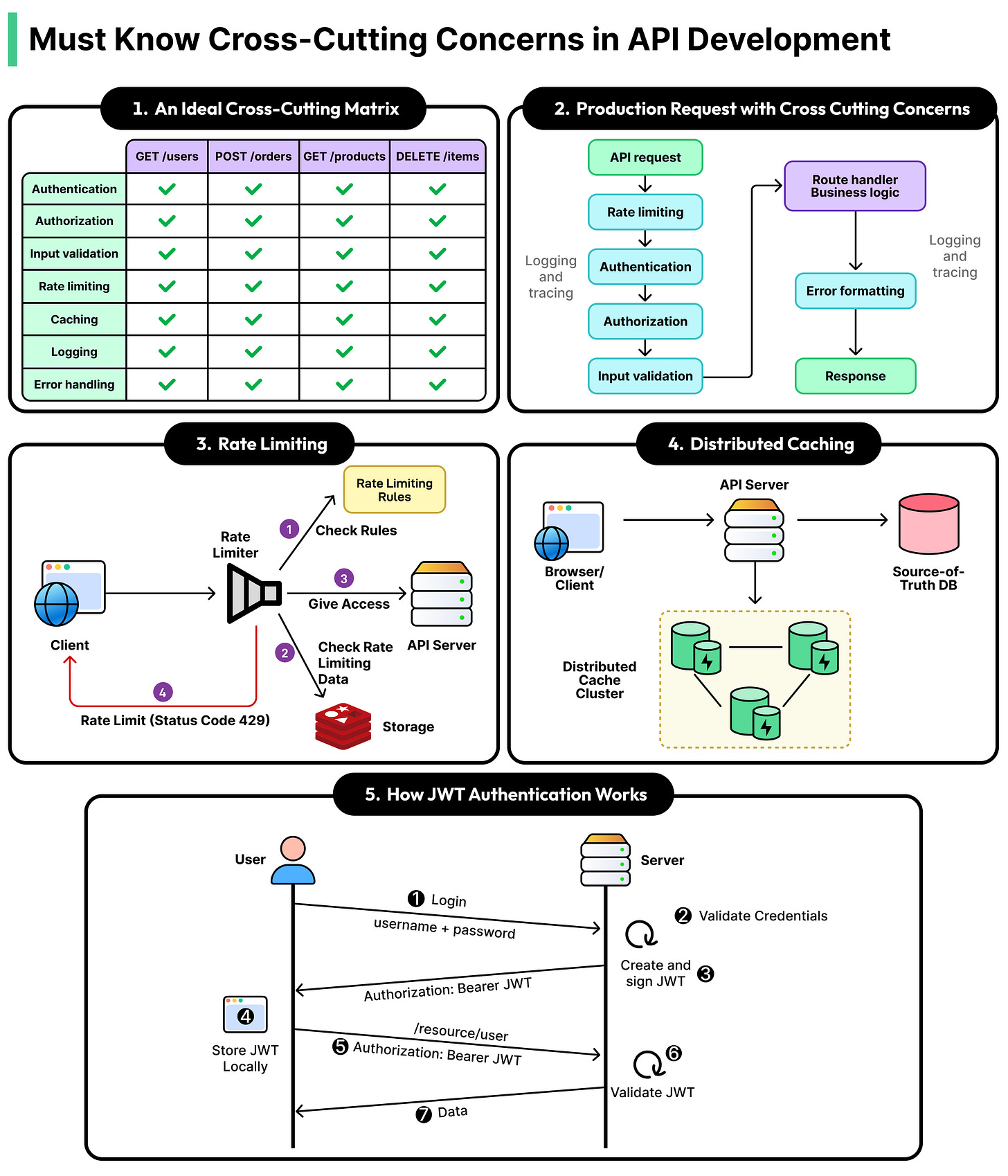
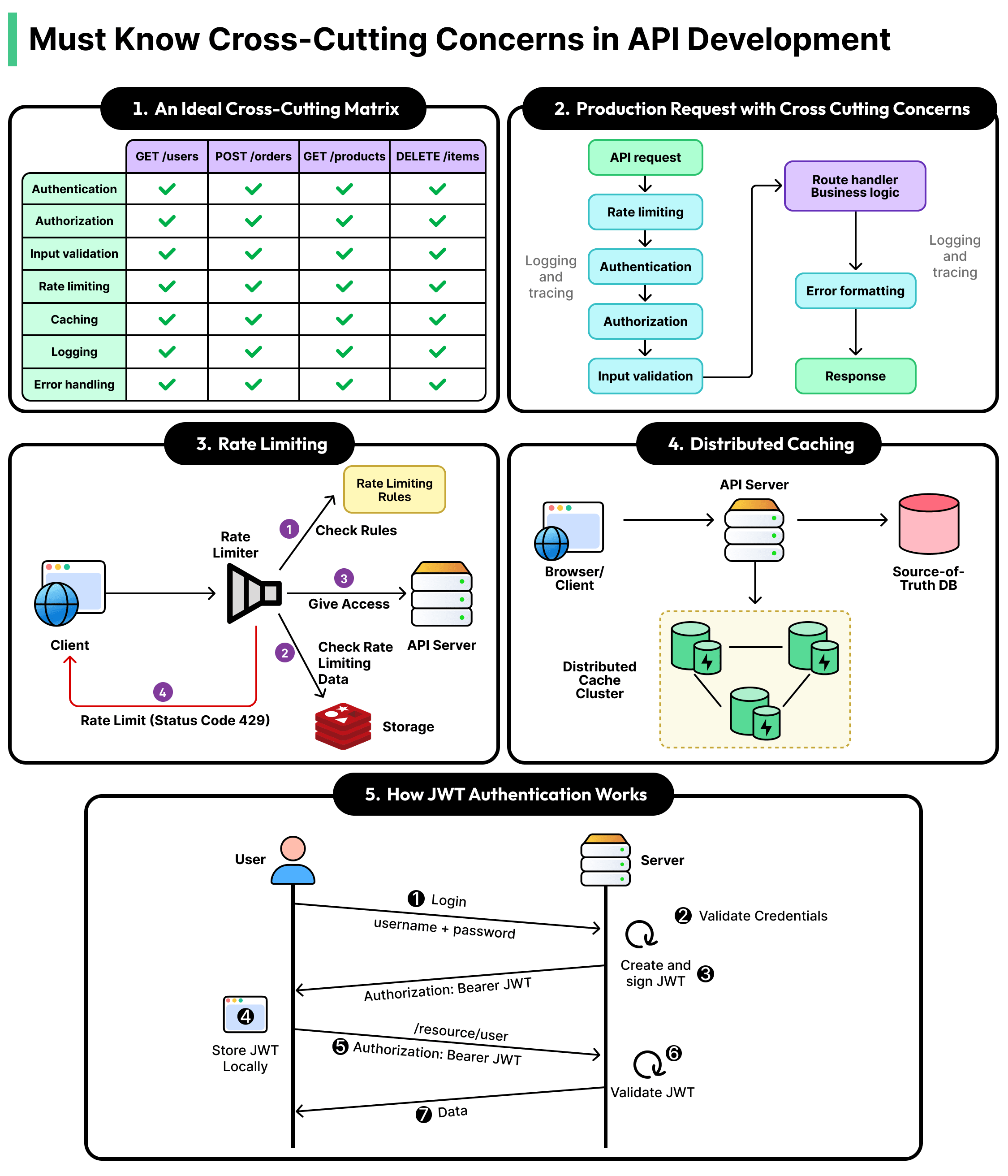
What do authentication, logging, rate limiting, and input validation have in common?
The obvious answer is that they’re all important parts of an API. But the real answer is deeper is that none of them belong to any single endpoint or show up in usual product requirements. For all purposes, they are invisible to users when they work and catastrophic when they’re missing. And the hardest part about all of them is making sure they’re applied uniformly across every single route an API exposes.
This family of problems has a name. They’re called cross-cutting concerns, and they’re the invisible layer that separates a collection of API endpoints from a production-ready system.
In this article, we will learn about these key concerns and their trade-offs in detail.
Once upon a time in Europe, television remote controls had a magic teletext button. Years before the internet stole into homes, pressing that button brought up teletext digital information services with hundreds of constantly updated pages. Living in Ireland in the 1980s and ’90s, my family accessed the national teletext service—Aertel—multiple times a day for weather and news bulletins, as well as things like TV program guides and updates on airport flight arrivals.
It was an elegant system: fast, low bandwidth, unaffected by user load, and delivering readable text even on analog television screens. So when I recently saw it was the 40th anniversary of Aertel’s test transmissions, it reactivated a thought that had been rolling around in my head for years. Could I make a ham-radio version of teletext?
What is Teletext?
First developed in the United Kingdom and rolled out to the public by the BBC under the name Ceefax, teletext exploited a quirk of analog television signals. These signals transmitted video frames as lines of luminosity and color, plus some additional blank lines that weren’t displayed. Teletext piggybacked a digital signal onto these spares, transmitting a carousel of pages over time. Using their remotes, viewers typed in the three-digit code of the page they wanted. Generally within a few seconds, the carousel would cycle around and display the desired page.
Teletext created unusually legible text in the 8-bit era by enlarging alphanumeric characters and interpolating new pixels by looking for existing pixels touching diagonally, and adding whitespace between characters. Graphic characters were not interpolated, and featured blocky chunks known as sixels for their 2-by-3 arrangement. My modern recreation uses the open-source font Bedstead, which replicates the look of teletext, including the graphics characters. James Provost
Teletext is composed of characters that can be one of eight colors. Control codes in the character stream select colors and can also produce effects like flashing text and double-height characters. The text’s legibility was better than most computers could manage at the time, thanks to the SAA5050 character-generator chip at the heart of teletext. Although characters are internally stored on this chip in 6-by-10-pixel cells—fewer pixels than the typical 8-by-8-pixel cell used in 1980s home computers—the SAA5050 interpolates additional pixels for alphanumeric characters on the fly, making the effective resolution 10 by 18 pixels. The trade-off is very low-resolution graphics, comprising characters that use a 2-by-3 set of blocky pixels.
Teletext screens use a 40-by-24-character grid. This means that a kilobyte of memory can store a full page of multicolor text, half the memory required for a similar amount of text on, for example, the Commodore 64. The BBC Microcomputer took advantage of this by putting an SAA5050 on its motherboard, which could be accessed in one of the computer’s graphics modes. Despite the crude graphics, some educational games used this mode, most notably Granny’s Garden, which filled the same cultural niche among British schoolchildren that The Oregon Trail did for their U.S. counterparts.
I wanted to do something a little different. Inspired by how the BBC Micro co-opted teletext for its own purposes, I thought it might make a great radio protocol. In particular I thought it could be a digital counterpart to slow-scan television (SSTV).
SSTV is an analog method of transmitting pictures, typically including banners with ham-radio call signs and other messages. SSTV is fun, but, true to its name, it’s slow—the most popular protocols take a little under 2 minutes to send an image—and it can be tricky to get a complete picture with legible text. For that reason, SSTV images are often broadcast multiple times.
Teletext is still remembered fondly by many.
I decided to send the teletext using the AX.25 protocol, which encodes ones and zeros as audible tones. For VHF and UHF transmissions at a rate of 1,200 baud, it would take 11 seconds to send one teletext screen. Over HF bands, AX.25 data is normally sent at 300 baud, which would result in a still-acceptable 44 seconds per screen. When a teletext page is sent repeatedly, any missed or corrupted rows are filled in with new ones. So in a little over 2 minutes, I could send a screen three times over HF, and the receiver would automatically combine the data. I also wanted to build the system in Python for portability, with an editor for creating pages, an AX.25 encoder and decoder, and a monitor for displaying received images.
The reason why I hadn’t done this before was because it requires digesting the details of the AX.25 standard and teletext’s official spec, and then translating them into a suite of software, which I never seemed to have the time to do. So I tried an experiment within an experiment, and turned to vibe coding.
Despite the popularity of vibe coding with developers, I have reservations. Even if concerns about AI slop, the environment, and memory hoarding were not on the table, I would still worry about the reliance on centralized systems that vibe coding brings. The whole point of a DIY project is to, well, do it yourself. A DIY project lets you craft things for your own purposes, not just operate within someone else’s profit margins and policies.
Still, criticizing a technology from afar isn’t ideal, so I directed Anthropic’s Claude toward the AX.25 and teletext specs and told it what I wanted. After about 250,000 to 300,000 tokens and several nights of back and forth about bugs and features, I had the complete system running without writing a single line of code. Being honest with myself, I doubt this system—which I’m calling Spectel—would ever have come about without vibe coding.
But I didn’t learn anything new about how teletext works, and only a little bit more about AX.25. Updates are contingent on my paying Anthropic’s fees. So I remain deeply ambivalent about vibe coding. And one final test remains in any case: trying Spectel out on HF bands. Of course, that means I’ll need willing partners out in the ether. So if you’re a ham who’d like to help out, let me know in the comments below!
Roughly 90 percent of hard tech startups fail due to funding constraints, longer R&D timelines for developing hardware, and the complexity of manufacturing their products, according to a number of studies.
Generally, these startups require up to 50 percent more investor financing than software ones, according to a Medium article. Typically, they need at least US $30 million, according to a Lucid article. That’s double the funding needed by software companies on average.
To help them connect with investors, IEEE Entrepreneurship in 2024 launched its Hard Tech Venture Summits. The two-day events connect founders with potential investors and other entrepreneurs. Attendees include manufacturers, design engineers, and intellectual property lawyers.
“Even though there are a lot of startup investor conferences, it’s hard to find those focused on hard tech,” says Joanne Wong, who helped initiate the program and is now the chair. She is a general partner at Redds Capital, a California-based venture capital firm that invests in global early-stage IT startups.
The IEEE member is also an entrepreneur. She founded SciosHub in 2020. The company’s software-as-a-service and informatics platform automates the data-management process for biomedical research labs.
“Many investors are focused on AI software—which is good,” she says. “But for hard tech companies, it is still hard to find support.”
The summit also includes a workshop to help founders navigate manufacturing processes and regulatory compliance. The event is open to IEEE members and others.
IEEE is a natural fit for the program, Wong says, because hard tech is synonymous with electrical engineering.
“Some of the domains we’re covering are robotics, semiconductors, and aerospace technology. IEEE has societies for all these fields,” she says. “Because of that, there are many resources within the organizations for startups, whether it be mentors or guides on how to commercialize products.”
There are several venture summits planned for this year. Two are scheduled in collaboration with the IEEE Systems Council: this month in Menlo Park, Calif., and in October in Toronto.
More events are being planned for next year in Asia, Europe, Latin America, and North America.
Networking and a pitch competition
Each summit includes keynote speakers, followed by networking roundtables. Each table is composed of people from three to five startups, one or two investors, and a service provider.
That arrangement helps founders build relationships, which is the summit organizers’ priority, Wong says. Investors at past events have included i3 Ventures, Monozukuri Ventures, and TSV Capital.
“The connection with the community was fantastic, especially investors and founders in robotics.” —Mark Boysen, founder of Naware
Startups present their pitch, which a number of investors evaluate before ranking the business plan and product. The top 10 startups pitch their business to all the investors.
On the second day, the startup founders participate in a half-day engineering design–to–manufacturing workshop, at which manufacturing engineers teach them how to navigate the process and meet regulations.
In an exhibition area, participants can see demonstrations from the startups and connect with service providers.
The 2025 event’s half-day engineering design–to–manufacturing workshop was led by Liz Taylor, president of DOER Marine. The company manufactures marine equipment.Larissa Abi Nakhle/IEEE
Positive feedback from attendees
In a survey of past summit attendees, startup founders said the event connected them not only with investors but also with other entrepreneurs having similar struggles.
“The connection with the community was fantastic, especially investors and founders in robotics,” said Mark Boysen, who founded Naware. The company, based in Edina, Minn., developed a robot that uses AI to detect and remove weeds from golf courses, parks, and lawns.
“I loved getting the investors’ perspectives and understanding what they’re looking for,” Boysen said.
Jeffrey Cook, who attended a summit in 2024, said he met “a lot of great contacts and saw what the hard tech venture climate is like.”
Attendees of the Hard Tech Venture Summit spend the first day networking and presenting their pitch to investors. IEEE Entrepreneurship
“Those in the community would benefit from coming to the summit,” said Cook, who founded Gigantor Technologies in Melbourne Beach, Fla. It develops hardware systems for AI-powered devices.
More than 90 percent of attendees at the 2025 event in San Francisco said they would highly recommend the summit to others, according to a survey.
Investors and service providers also have found the events successful.
Ji Ke, a partner and the chief technology officer of deep tech VC firm SOSV, attended the 2025 summit.
“I met a lot of young entrepreneurs tackling some big challenges,” he said. “This is one of the best events to meet some very-early-stage companies.”
Preseed founders are seeking small investments to get their businesses off the ground. Those in the seed stage have already secured funding from their first investor. Series A startups have obtained funding and are developing their product.
Applicants are reviewed by a committee of investors to ensure the startups would be a good fit. Those who are approved are matched with investors and service providers based on their specialty.
“The journey for a hard tech startup is very long and arduous,” Wong says. “Founders need to meet as many investors as possible and other people who support hard tech systems so that they’re able to reach out to them for advice or help.”
Those interested in learning more about an upcoming event can send a request to entrepreneurship@ieee.org.